
Details
DRM: Digitales Wasserzeichen
Weitere Details
1. Auflage 2007
21.01.2007
English
294 S., 2.63 MB
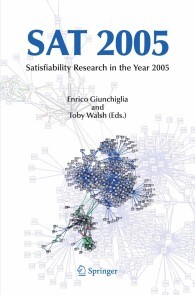
SAT 2005
eBook - Satisfiability Research in the Year 2005, Springer Nature Proceedings Computer Science
Beschreibung
This book is devoted to recent progress made in solving propositional satisfiability and related problems. Propositional satisfiability is a powerful and general formalism used to solve a wide range of important problems including hardware and software verification. The core of many reasoning problems in automated deduction are propositional. Research into methods to automate such reasoning has therefore a long history in artificial intelligence. In 1957, Allen Newell and Herb Simon introduced the Logic Theory Machine to prove propositional theorems from Whitehead and Russel's "Principia mathematica".
In 1960, Martin Davis and Hillary Putnam introduced their eponymous decision procedure for satisfiability reasoning (though, for space reasons, it was quickly superseded by the modified procedure proposed by Martin Davis, George Logemann and Donald Loveland two years later). In 1971, Stephen Cook's proof that propositional satisfiability is NP-Complete placed satisfiability as the cornerstone of complexity theory.
Inhalt
E-Book Informationen
Um die PocketBook Cloud zu aktivieren, loggen Sie sich bitte in Ihrem Kundenkonto ein und gehen dort in den Bereich „E-Books“. Setzen Sie hier einen Haken bei „Neue E-Book-Käufe automatisch zu meiner Cloud hinzufügen.“. Dadurch wird ein PocketBook Cloud Konto für Sie angelegt. Die Zugangsdaten sind dabei dieselben wie die Ihres Kundenkontos in diesem Webshop.
Weitere Informationen zur PocketBook Cloud finden Sie unter www.meinpocketbook.de.
Allgemeine E-Book-Informationen
E-Books in diesem Webshop können in den Dateiformaten EPUB und PDF vorliegen und können ggf. mit einem Kopierschutz versehen sein. Sie finden die entsprechenden Informationen in der Detailansicht des jeweiligen Titels.
E-Books ohne Kopierschutz oder mit einem digitalen Wasserzeichen können Sie problemlos auf Ihr Gerät übertragen. Sie müssen lediglich die Kompatibilität mit Ihrem Gerät prüfen.
Um E-Books, die mit Adobe DRM geschützt sind, auf Ihr Lesegerät zu übertragen, benötigen Sie zusätzlich eine Adobe ID und die kostenlose Software Adobe® Digital Editions, wo Sie Ihre Adobe ID hinterlegen müssen. Beim Herunterladen eines mit Adobe DRM geschützten E-Books erhalten Sie zunächst eine .acsm-Datei, die Sie in Adobe® Digital Editions öffnen müssen. Durch diesen Prozess wird das E-Book mit Ihrer Adobe-ID verknüpft und in Adobe® Digital Editions geöffnet.